

‘Sinister industry’: Kansas City company behind 7-OH & a growing opioid epidemic
7-OH and American Shaman
Neil Nakahodo
In late July, inside the Las Vegas Convention Center, a middle-aged man named Curtis was selling Cocaine.
Not the little bags of white powder. Cocaine, with a capital C — a retail beverage that contains nearly twice the amount of caffeine as a Rock Star energy drink and has managed to fight off multiple federal agencies who’ve sought to strip the brand of its provocative name.
“It’s great for a pre-workout, and it really pops with alcohol,” said Curtis, who works for a manufacturer named Hype Beverages and declined to give his last name.
Nearby, representatives from a company called GreatWhip showcased whipped cream canisters — a puzzling exhibition unless you also knew that the nitrous oxide inside those canisters can be inhaled for a brief, euphoric rush called a “whippet.” On another vendor’s table sat several gallon-sized bags of a green plant — not marijuana, but hemp flower rich in THC-A, which can be sold without a dispensary license in many states.
If that all sounds a little sketchy and borderline, there’s a good reason for it. This was the CHAMPS Trade Show, which functions as a kind of swap meet for buyers and sellers of legally iffy intoxicants typically found behind the counter at smoke shops and off-brand gas stations. It took over two floors of the convention center and was not open to the public.
The event is held multiple times per year. It is where an industry built on selling cheap highs in shadowy markets shifts to extrovert mode, exposing its underbelly beneath bright lights. CHAMPS is also a place to scout new trends, and in July one was impossible to miss: 7-hydroxymitragynine, better known as 7-OH, had taken over the show floor. Roughly half of the 400 vendors in attendance were selling some version of it.
An opioid born from kratom, 7-OH is considered by researchers to be far more powerful than morphine, with a correspondingly high potential for addiction. Two years ago, few people at CHAMPS had ever heard of 7-OH. Now a gold rush was underway. The biggest, gaudiest installations — more mini-nightclubs than trade-show booths, with LED walls, carpeted lounges, and young women in tight clothes — belonged to the companies hawking it.
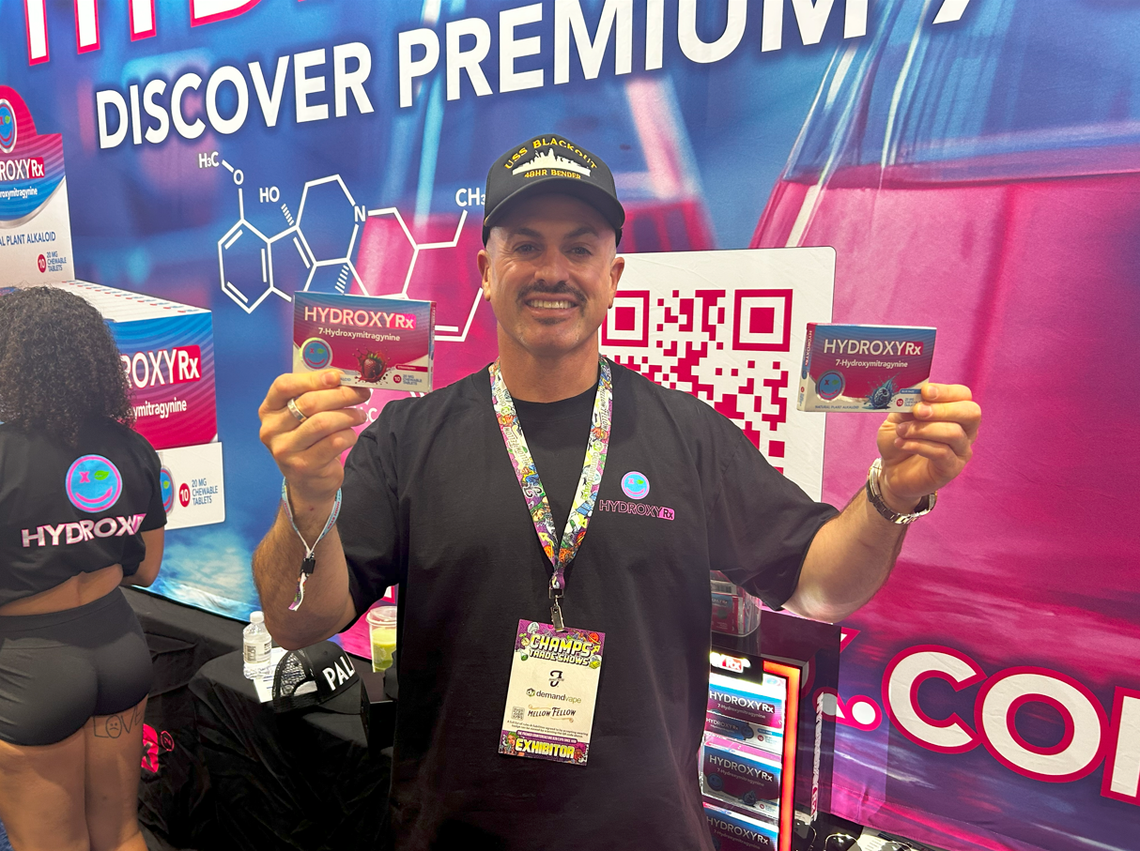
“Sales are moving into the millions, and we haven’t even been in business for a year,” said HydroxyRx owner Ryan Lewis, who was wearing a naval veteran-style cap that said “USS Blackout – 48 Hour Bender” and selling 7-OH pills in packaging that looked like a box of Benadryl.
Even Curtis’ company, Hype Beverages, was getting into the 7-OH business with a product called Bliss Xtra. “Kratom is going out, and 7-OH has been coming in,” Curtis said.
Because it exists in a gray zone of commerce, the true size of the 7-OH trade is tough to pin down. Estimates range from $2 billion to $8 billion.
But one fact is clear: A surprising amount of it runs through Kansas City.
Vince Sanders, president and founder of locally based CBD American Shaman, spent the past decade turning hemp oil and other cannabis products into a nationwide retail empire of several hundred stores. Now he’s at the forefront of the 7‑OH surge, a phenomenon that a growing number of people are comparing to the early days of the opioid epidemic.
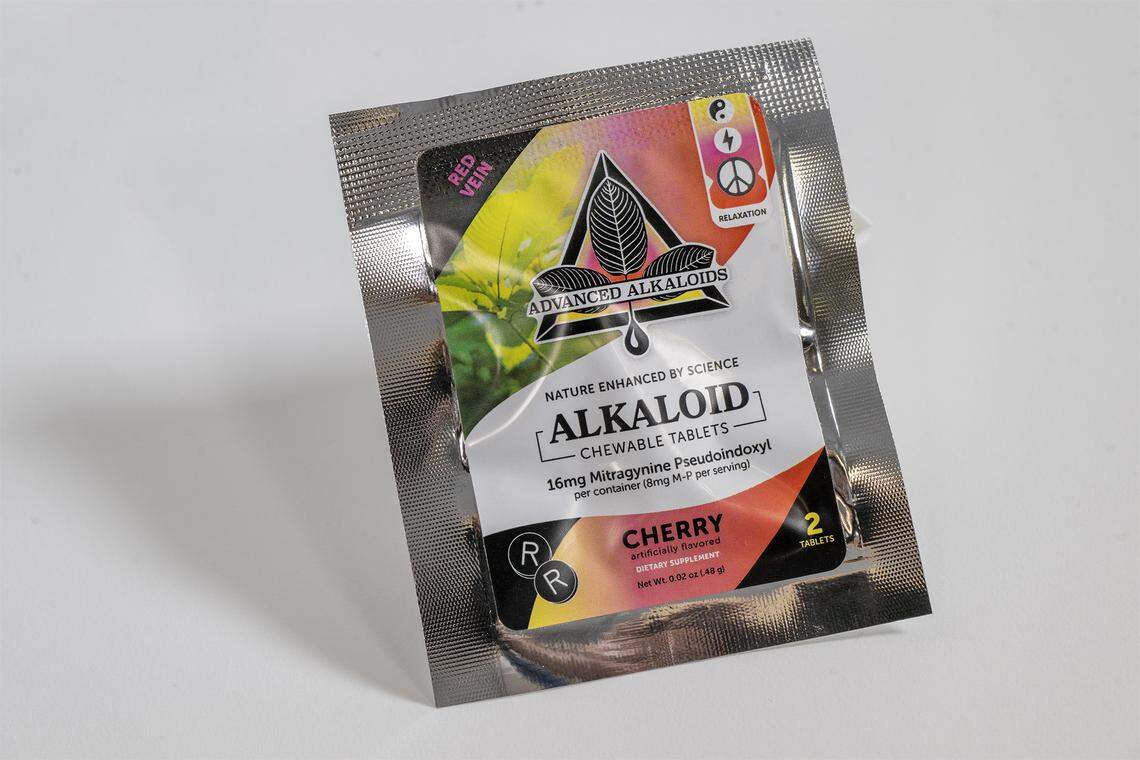
American Shaman was among the earliest, if not the first, to market 7‑OH, selling it since early 2024 through its Advanced Alkaloids line in retail shops alongside CBD and other cannabis products. Sanders owns a sister company, Shaman Botanicals, that makes the products at a facility in Riverside, where he relocated earlier this year after Kansas City shut down his operation on Southwest Boulevard. Shaman Botanicals also manufactures 7-OH by the truckload for many other brands selling the drug — a role that has made Sanders a godfather-like figure in this emerging market.
It has also made him a target.
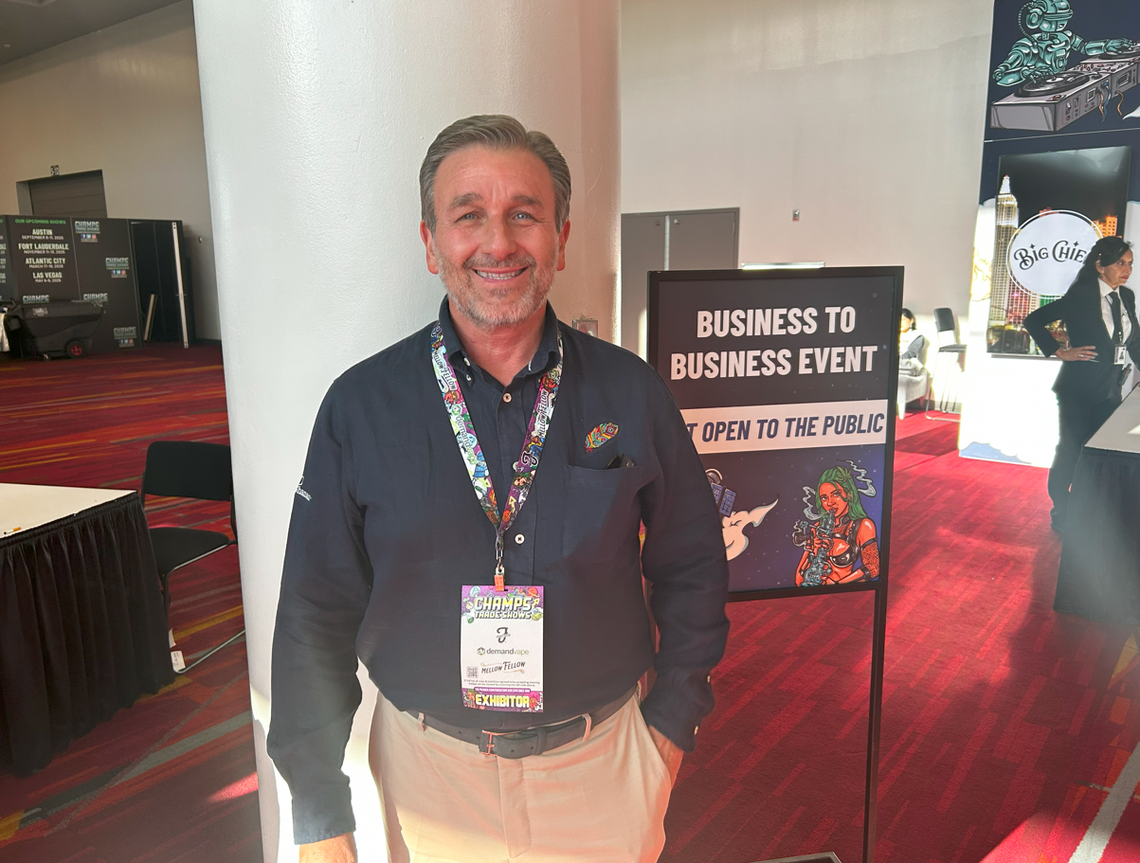
Two recently filed class-action lawsuits accuse Sanders’ companies of misleading consumers about 7-OH and other products. One says Sanders “formulated 7-OH to be extremely physically and psychologically addictive” — a claim made more credible by rapidly growing online forums like r/quitting7oh, a subreddit where users share experiences of intense dependency and strategies for quitting.
“When reasonable consumers think of opiates and opioids, they think of heroin, fentanyl, hydrocodone, oxycodone, and morphine,” attorneys in one of the lawsuits allege. “They do not expect that the ’all natural’ product bought at their local corner store operates like an opioid, with similar addiction and dependency risks.”
Federal regulators have also taken notice. This summer the Food and Drug Administration sent Shaman Botanicals a warning letter, one of seven issued to companies marketing 7-OH in gummies, shots, tablets and powders. The agency said the ingredient cannot legally be added to dietary supplements or foods, and warned that consumers were being exposed to “unproven, potentially dangerous products.”
At CHAMPS, Sanders, 61, brushed all that off. He said he did not expect to shut down production of 7-OH. He boasted that of the seven companies hit with FDA warnings, he was white-labeling 7-OH for six of them. “If you go out onto the (convention) floor, there’s a couple dozen companies there whose 7-OH products we make,” Sanders said.

Sanders, who has lived in the same Johnson County duplex since 2008, declined to specify exactly how much money that meant to American Shaman and Shaman Botanicals’ bottom line. But he offered a hint.
“Our cannabis business is about $100 million a year,” he said. “And our 7-OH business is now significantly larger than that.”

7-OH targeted by the FDA
On July 29 — just three days after CHAMPS cleared out — Health and Human Services Secretary Robert F. Kennedy Jr. and Food and Drug Administration Commissioner Marty Makary stepped to a podium in Washington, D.C., and declared the 7-OH party over.
“This is a really sinister, sinister industry, and our agencies have been asleep at the wheel,” Kennedy said.
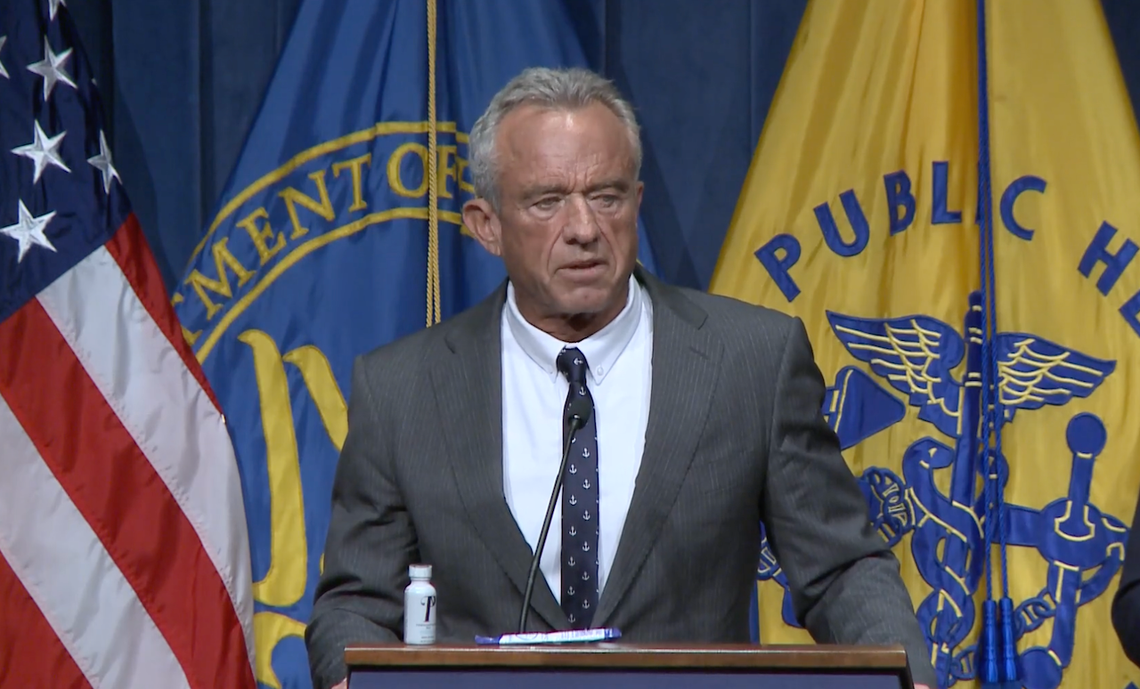
“7-OH is an opioid that can be more potent than morphine,” Makary added. “We need regulation and public education to prevent another wave of the opioid epidemic.”
Makary announced that federal health officials were formally asking the Drug Enforcement Administration to classify 7-OH as a Schedule I controlled substance — lumping it in with heroin, LSD and ecstasy, and yanking it out of the gas-station gray market where it had flourished.
Several layers of review and regulation stand between the FDA’s recommendation and 7‑OH disappearing from stores. But it was a game-changing announcement in the CHAMPS universe — a moment for which Todd Underwood had been waiting two years.
“There’s a group of us who’ve been sounding the alarm about 7-OH since 2023, warning the FDA this was potentially a whole new opioid epidemic,” said Underwood. “We thought, they can’t possibly sit back and let this happen again. But they did.”
Underwood is not a regulator or a public-health crusader. He’s a businessman. He owns Mit Wellness, a Kansas City area company that manufactures kratom extracts out of a facility just south of Independence Square.
Underwood has muscular dystrophy and has endured three heart attacks and a quadruple bypass. He spent years relying on opioids to manage his chronic pain. In 2019, he found kratom. He tried it once, quit opioids cold turkey, and says he hasn’t touched them since. He founded Mit Wellness in 2022 and is a member of the American Kratom Association, a lobbying and advocacy group that works to keep kratom legal in the U.S., promote consumer safety standards, and push back against efforts to ban or heavily restrict the plant.
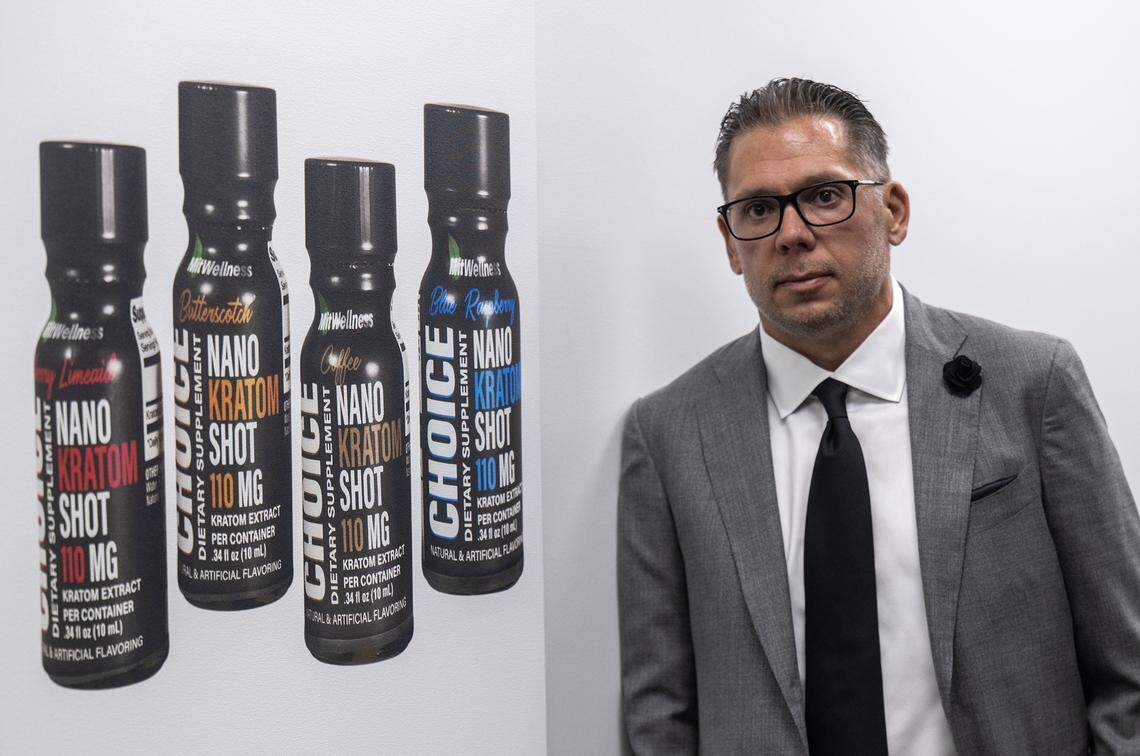
No stranger to controversy or conflict, Underwood once ran a firearms marketplace that made headlines for hosting an auction of the handgun used in the Trayvon Martin shooting, in which the 17-year-old was killed by a member of a community watch organization while walking in Miami Gardens, Florida.
A few years later, Underwood appeared on the cover of New York Magazine for a story that explored his life as a gun enthusiast and entrepreneur. He showed up to CHAMPS with Frank Mir, the former UFC heavyweight champion, who is also a brand ambassador for Mit Wellness. He insinuated that Mir was there, in part, for protection.
“There’s a chance things could get violent,” Underwood said.
He was referring to a dynamic that was becoming more apparent at the conference: a rift between 7-OH companies and traditional kratom companies. It would culminate on the final day of CHAMPS with a seminar titled “The 7-OH Fault Line: Can the Industry Find Common Ground?” One of the few academic offerings at the trade show, it was structured as a debate between the American Kratom Association and the Holistic Alternative Recovery Trust, or HART, a new, pro-7-OH group founded — and largely funded — by Sanders.
Underwood and the AKA have drawn a hard line against 7-OH. They see it as an adulterated product masquerading as kratom — a threat to both public health and kratom’s reputation.
“There’s plenty of science that backs up the safety of our products — of kratom and kratom extracts,” Underwood said. “When these companies released 7-OH, they had done no clinical studies, they had no reasonable expectation of safety, they had not filed a New Dietary Ingredient notification with the FDA. It was just a money grab.”
‘Four whole trees worth of kratom’
While 7-OH is a relatively new product, kratom is not. The tropical tree has been used for centuries in Southeast Asia to relieve pain and boost energy. In the U.S., it didn’t become widespread until the opioid epidemic pushed people to look for less addictive, over-the-counter substitutes for withdrawal and chronic pain. By the mid-2010s, kratom was a smoke-shop staple, federally legal but largely unregulated, sold in a patchwork of state and local markets where bans and restrictions vary to this day.
Sanders claims credit for developing 7-OH as a product. He says that a few years ago he came across a 2019 NIH study showing that rodents given kratom metabolized a small share of its main alkaloid into 7-OH — and that the therapeutic effects were tied to that compound, not kratom itself. Convinced 7-OH was the “real medicine,” he halted other research at CBD American Shaman and directed his chemists to focus entirely on producing it.
He ended up with what is, in effect, a lab-tweaked remix of kratom, tuned to light up opioid receptors. Sanders and other 7-OH manufacturers extract mitragynine — the main active alkaloid in kratom — and chemically convert it into 7-OH, which is far more potent and addictive. Analogies abound. To Sanders and supporters, 7-OH represents pharmaceutical progress — an automobile compared with traditional kratom’s horse-and-buggy pace. To critics, it’s a dangerous leap: Traditional kratom is a cup of coffee, 7-OH a crack rock.
“You’d have to consume four whole trees worth of kratom leaves to get the amount of 7-OH in a typical 7-OH pill you find on the market today,” Underwood said. “The average person might think, well, it comes from kratom, so it must be kratom. But it’s really not.”
Mac Haddow, a policy advisor for the AKA who represented that group, offered a similar analogy during the CHAMPS debate. Apple seeds, he explained, naturally contain tiny amounts of amygdalin, which can release trace amounts of cyanide when chewed. It’s not enough to harm anyone. But it would be a different story if the amygdalin was extracted and concentrated into a pill.
“Would anyone in their right mind call that pill an apple?” Haddow said. “Obviously not. It is a chemical reformulation of apple seeds into cyanide. And so (with 7-OH) we cannot use this false equivalency of saying, ‘Oh, it’s a plant. It’s safe.’ It’s not.”
Across the stage from Haddow, tasked with selling HART’s vision, was Jeff Smith. Once a rising star in Missouri Democratic politics, his ascent was cut short after a 2009 conviction for obstruction of justice tied to his 2004 congressional campaign. Smith did a year in federal prison, wrote a book about his experience, and resurfaced as a prison-reform advocate.
Now, Smith was working for the Sanders-funded 7-OH nonprofit. From the podium, he attempted to change the narrative around 7-OH from a gas-station high to a breakthrough therapy for pain and addiction.
It was a particularly tough message to get across given the circumstances. Just down the hall, the actual 7-OH business was on full view. Brands with names like Perks (a wink at the painkiller Percocet) and Smurph’s (chewable tablets in Blue Razz and Cotton Candy) pushed their wares in neon-colored packs containing ever-higher doses. The scene bore little resemblance to a sober public-health movement.
What is 7-OH?
-
Kratom, a tropical tree used for centuries in Southeast Asia to ease pain and boost energy, became popular in the U.S. during the opioid crisis as a plant-based alternative for withdrawal and chronic pain.
-
Manufacturers take mitragynine, kratom’s main active compound, and chemically convert it into 7-hydroxymitragynine (7-OH).
-
Companies sell 7-OH pills (and shots and gummies) in gas stations, smoke shops, and online.
-
These synthetic products are far more potent and addictive than the kratom plant’s natural leaves.
Defending 7-OH — he said he uses it to help him sleep — Smith argued, contrary to all the talk of a new opioid crisis, that there’s no evidence the compound is causing overdoses.
“Where are the breathless nightly news segments? Where’s the spike in poison control calls? I’ve talked to ER doctors in St. Louis, New York, Atlanta, San Francisco — they’d never heard of 7-OH. They’d heard of Tranq. They’d heard of xylazine mixed with fentanyl. Not this.”
He pointed to state-level data suggesting the drug might even help people transition off more harmful opioids: Utah, which has enforced a strict 7-OH ban, recorded the nation’s largest jump in fatal overdoses in 2024, Smith said, while West Virginia, Virginia and Florida — where 7-OH use is highest — saw deaths fall by “up to 40%.”
“Correlation doesn’t equal causation,” he acknowledged, “but that data should at least caution policymakers against rushing to ban a substance that might have tremendous potential.”
(CDC figures do show that Utah was among only a handful of states that saw an increase last year in overdose deaths; they increased 8% in that state. But while West Virginia, Virginia and Florida saw declines in opioid deaths, that decline is generally consistent with the patterns in many other states in the country, including Wisconsin and Arkansas, where 7-OH is banned. Florida also banned 7-OH a few weeks after CHAMPS.)
Smith said HART’s priorities include accurate labeling of 7-OH ingredients, clear warnings and instructions, monitoring adverse events, keeping products away from minors, and avoiding medical claims in marketing.
“We want regulation,” he said.
A KC kratom feud
No fight broke out at the seminar. The discussion was respectful on both sides. Seated in front of Smith, Sanders nodded emphatically and occasionally clapped as Smith laid out his talking points.
In the hallway after the debate, Sanders framed the conflict between the two sides as an economic one, not a safety one.
“This is a group of business people who were in the right place at the right time,” Sanders told The Star of traditional kratom companies. “Many of them are ex-addicts that took kratom and got off heroin or opiates through it. They’re not really business whizzes. They made a lot of money for a while and had a nice industry.”
But, he continued, “Things changed. And now, with 7-OH, we have a far superior product. And rather than compete with us, they are trying to legislate us out of the market. And that’s not going to happen.”
If that sounded like Sanders was taking a shot at Underwood, it was likely not an accident. From 2016 to 2022, Underwood served as chief operating officer for CBD American Shaman. The two men now despise one another.
Toward the end of Underwood’s time at the company, they partnered on a kratom company, Triumph Kratom. Then, Underwood says, two things happened. He noticed that Sanders was stocking CBD American Shaman locations with inventory taken from Triumph. And Sanders began manufacturing tianeptine, an antidepressant sometimes referred to as “gas station heroin” that acts less like Prozac and more like an opioid, delivering euphoria and drowsiness.
“When Vince decided to do tianeptine, that ended my involvement with Shaman,” Underwood said. “I’m like, I’m not creating a brand to f— people up. I’m creating a health brand to give people relief.”
Sanders denies his company made tianeptine products, though another former employee also claims in court documents that Shaman Botanicals sold tianeptine, and FDA reports reviewed by The Star list Shaman Botanicals as a distributor of a tianeptine product that was later recalled. Sanders says that rather than quitting, Underwood was fired for being an incompetent employee.
“He’s the biggest scumbag lowlife I’ve ever met in my life,” Sanders said of Underwood. “He tried to make 7-OH and couldn’t figure it out. And now he’s on this incredible anti-Vince Sanders campaign. It’s nonsense.”
Underwood says he’d never sell 7-OH.
“I have a conscience,” he said. “I couldn’t manufacture, distribute, or get behind a product like 7-OH and be able to sleep at night. There’s so much harm it’s creating. And the reason it has grown so quickly is because of how addictive it is. It releases a ton of dopamine, a lot of euphoria.
“It is simply a drug,” Underwood added, noting that Sanders has a background in selling illicit drugs.
That much is true. Sanders is a twice-convicted drug dealer. He has also sold plenty else on the edge of the law. And he has left behind a long paper trail.
This story was originally published September 16, 2025 at 5:00 AM.